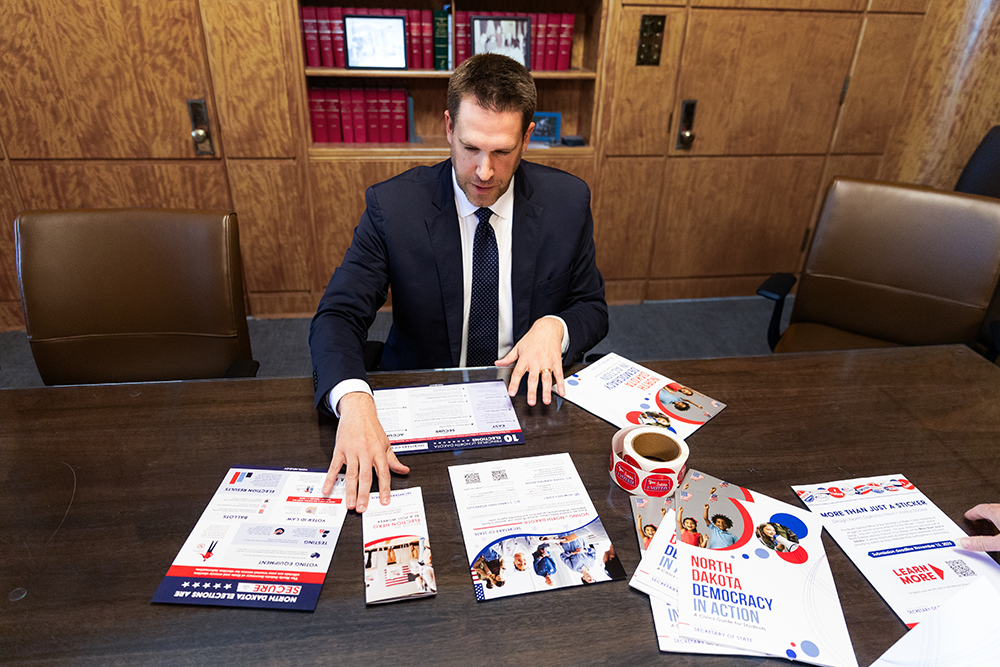
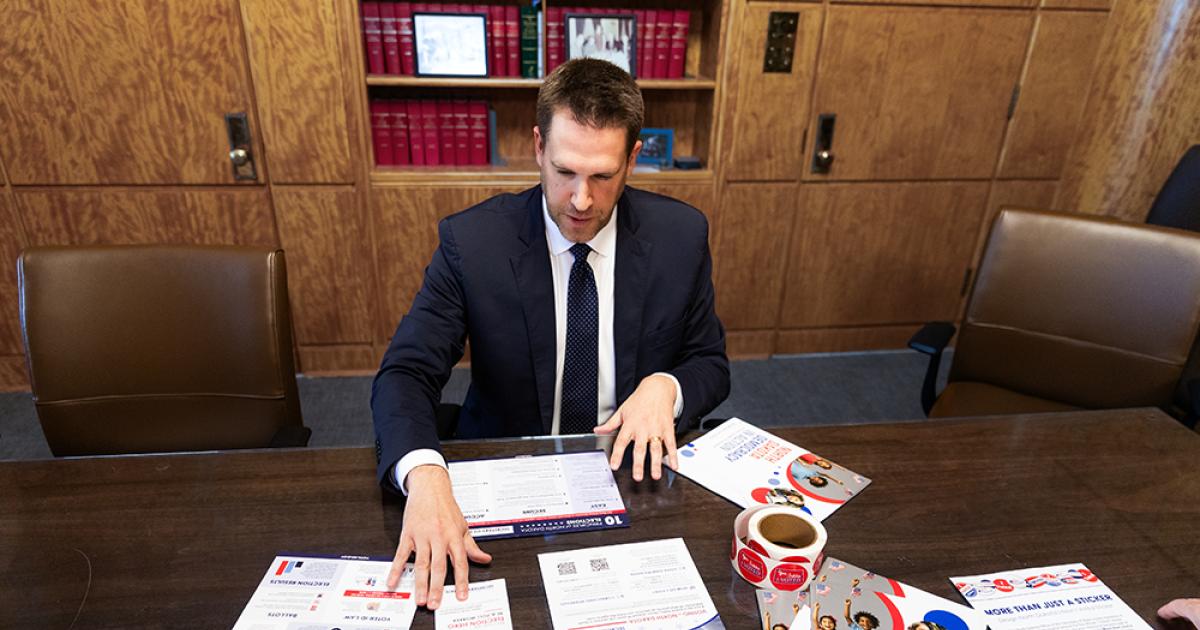
N.D. Secretary of State Michael Howe looks over some of the materials developed by his office to share with businesses and organizations to encourage civic engagement. Photo by NDAREC/Kennedy Delap
Growing up on a farm near Casselton, Michael Howe never imagined his family’s dinner conversations would inspire an initiative he would later launch as North Dakota’s secretary of state.
“My parents, I would say, are very civically engaged, and I grew up talking about policy at the kitchen table. My parents never ran for office, but we had the 6 o’clock news on during dinner, and you would hear about the events of the day,” he says.
Now, Howe encourages other North Dakotans to understand the benefits of those types of dinner table conversations.
The secretary of state’s new civic engagement initiative seeks to empower citizens by encouraging them to participate in decisions that impact them, their families and neighbors.
Civic engagement vs. politics
Civic engagement and political involvement are two different aspects, Howe clarifies.
“Civic engagement is what you want for your community, being active in your community and wanting your community to be a better place for yourself, for your family, for your friends, for your business,” he says. And that community could be your local club, school, city, county, state or even your nation.
Politics, on the other hand, is the red or blue jersey worn as an extracurricular of civic engagement, he says.
“Politics shouldn’t be a derogatory term. I want to make that clear. It’s, ‘Hey, I believe in this principle. You do, too. Let’s gather our people that think the same way and try to get more people to participate.’ With civic engagement, there is no jersey color. It’s everyone collectively getting together, engaging with your officials or volunteering,” Howe says.
And the most basic tenet of civic engagement is voting, he says.
“Voting is actually the easiest way to be civically engaged,” he says.
North Dakotans may not be engaging at that “easiest level,” with just under 21% of the state’s residents casting a ballot in the June primary election, which is not unlike many states. During presidential elections, that number averages 63%, Howe says.
In the June primary election, that means 80% of North Dakotans opted not to participate.
“You’re electing your mayor, your city council. You’re nominating people to be representatives of the county. You’re deciding who’s going to serve and represent you at the school district, and 80% of people opt not to participate,” he says.
But civic engagement matters, Howe says.
“We’re a representative government. Democracy and a representative government only works if people are engaged, and understand and are educated about the issues. And you can make informed choices, which then benefits not only yourself and your business and your family, but your neighbors as well,” Howe says.
“Get involved, have your say, get other people involved, too, whether it’s like-minded folks or even people who disagree with you to have that robust discussion,” Howe says.
But the civic engagement initiative is broader than just casting a ballot.
Increasing voter turnout should be the role of partisan parties, activists or candidates, Howe says.
“It’s their role to shake the trees and get people out to vote,” Howe says.
Increasing awareness
The secretary of state’s role is to educate the public about voting, so the civic engagement initiative focuses on helping people become informed voters, and encouraging conversations.
The initiative includes educating voters about options when marking a ballot and different methods of voting. For example, voters don’t have to mark every race if they are unfamiliar with the candidates, Howe says.
“So, maybe lifting that burden of, ‘Oh, I don’t want to vote, because I don’t know who any of these people are.’ That’s fine. Now, we encourage you to do your research, of course, and be active, but if you only want to vote for your one state legislator, you absolutely can do that and your ballot will still count,” Howe explains.
The first step in the civic engagement initiative was choosing the state’s “I voted” sticker through a contest opened to every North Dakota resident, resulting in 478 entries from 72 communities.
Another aspect of the initiative is Howe’s speaking engagements with groups all across the state on “Elections 101.”
To cast a wider net, the secretary of state’s office developed nonpartisan information to help businesses or organizations “spread the good word of being civically engaged.”
The toolkit includes a letter from Howe about the importance of being civically engaged, shareable graphics, educational printed materials about voting and educational walk-through videos with Howe explaining different aspects of casting a ballot.
Toolkit materials can be downloaded from the office’s website at vote.nd.gov/impacttoolkit.
As November approaches, the office hopes to expand its network for the new initiative.
Organizations and business can tailor the toolkit to fit their needs. They can also subscribe to email updates leading up to an election, which include suggestions about what messages and materials to share based on election dates and deadlines.
“This isn’t politics we’re discussing. This is civic engagement,” he reminds users. “My hope is that the business community embraces that. And again, in a nonpartisan fashion.”
The office also produced resources on how to run for office.
“We’re more than willing to walk anybody of all political stripes through the process of what to do,” he says.
The initiative also includes a student aspect.
Engaging students
Howe remembers taking a field trip to the state Capitol during junior high school, which had an impact on him as well.
“That’s influential to a young person,” he says.
“If we can get young people to be civically engaged or understand what that means at a young age, they’re more likely to carry that knowledge with them as they get older. We want to help them see why voting is important, why being engaged in their community is important,” he says.
The office developed a free activity book for upper elementary students and will be providing details about how teachers can get the books for their classrooms.
And Howe encourages high school students to research who represents them at every level of government, from Congress to township supervisors, then contact them for an introduction.
“That’s civic engagement,” Howe says.
“If you do have a problem or a concern or a question, now you’ve established that relationship with the people that represent you, and they’re going to remember you. It’s easier to have a conversation after you shake hands and say hello,” he says.
While many may avoid talking about politics, civic engagement is a different topic, Howe says. So, he encourages those one-on-one conversations with others by mentioning an upcoming election and encouraging a genuine informed conversation.
“What would define success is if people are able to talk about being civically engaged without going at each other’s throats,” Howe says. “We’re all part of team progress and prosperity.”
___
Luann Dart is a freelance writer and editor who lives in the Elgin area.