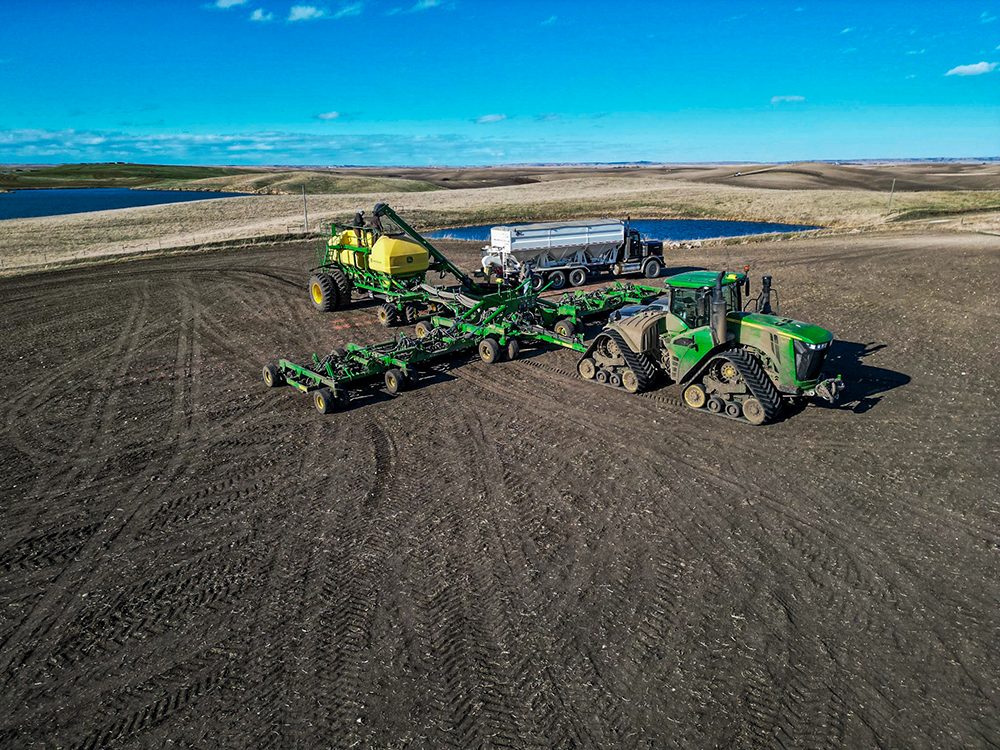

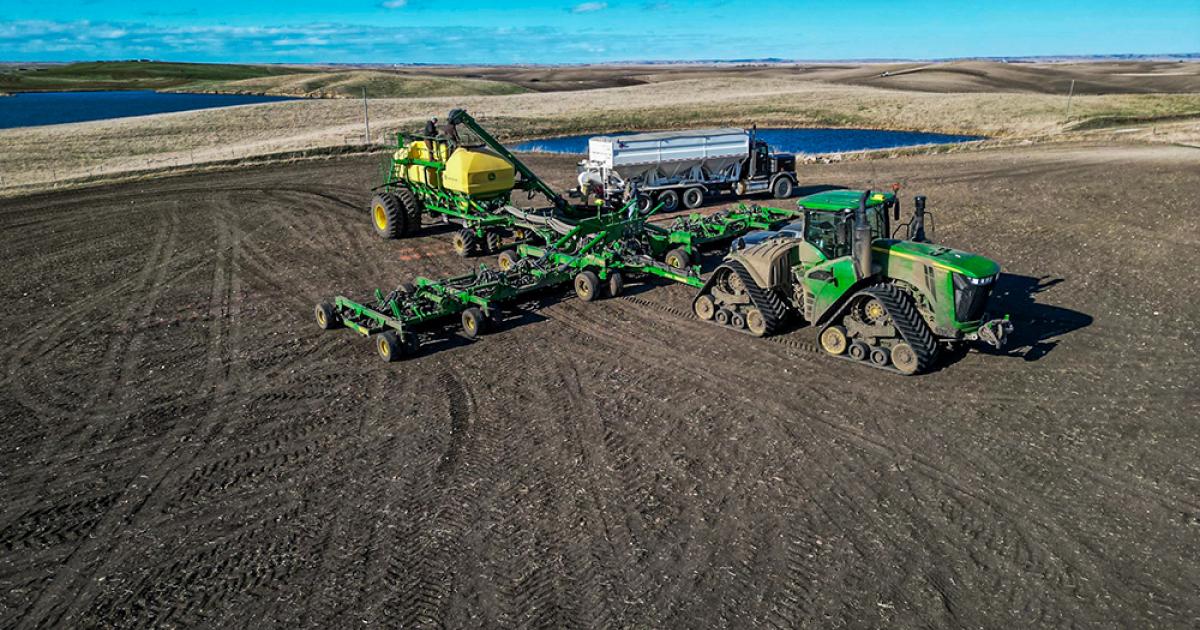
Fourteen-year-old James Ongstad used his drone to capture spring planting on his family farm in Kidder County in April. The farm is served by Verendrye Electric Cooperative and Northern Plains Electric Cooperative.
From the rolling row crops in the east to the rugged wheatfields of the west, North Dakota’s electric cooperatives have a top priority for everyone in the field: ensuring every farmer returns home safely.
Power lines are necessary to deliver electricity to hardworking farmers and ranchers, but those same power lines can be deadly if not treated with respect. While farmers need to focus on the field and their machinery, your local electric cooperative urges you to also watch for electrical hazards.
During planting and harvesting, electric cooperatives receive reports of farmers striking poles on field edges, sometimes breaking a pole entirely.
Verendrye Electric Cooperative, for example, reported five accidents in 10 days involving farm equipment striking power poles this spring.
“It goes in spurts. We expect a few every year, but I thought this year maybe we had more than normal,” says Burton Atkinson, operations manager with the cooperative, which has offices in Velva and Minot.
“We like to remind them to be mindful. I know they are busy and they’re really working hard and sometimes they’re putting in long days and maybe get a little tired, but use care around power poles,” he says.
What’s the No. 1 rule lineworkers want to share?
Always keep equipment at least 10 feet away from power poles. Look up, too. New equipment may be taller than anticipated. Typical electric distribution lines are a minimum of 18 feet from the ground.
“Today’s equipment is larger than ever,” Atkinson says, emphasizing the need for operators to maintain adequate clearance from power poles.
“Take your time and use caution. It may slow things down slightly, but it ensures the job gets done safely,” he adds.
And make sure everyone working on the farm is aware of power line locations.
“Sometimes a farming or ranching operation may have hired hands who do not realize anything is in the way,” says Jason Bentz, co-general manager/CEO of the Innovative Energy Alliance Cooperative, which provides management services to four electric cooperatives. “It’s important to pass along any information or awareness of potential hazards to hired help, including watching for power line poles.” Bentz was a lineworker himself for about 10 years and often took those calls.
“When a call came in, my first thought was just hoping everyone stayed in the vehicle, so nobody gets hurt,” Bentz says. “Equipment can be repaired – people can’t always.”
As farmers use more equipment with auto-guidance systems, less focus is needed on steering, which may lead some drivers to think they do not need to be as aware of navigation issues. However, even while using a GPS with auto-steering, farmers need to keep safety in mind and stay focused on their surroundings.
North Dakota’s electric cooperatives have had accident reports from farmers who are trusting their auto-guidance systems blindly and hitting power poles and other infrastructure.
Other vital advice: If power lines fall onto the tractor during an accident, stay in the tractor and call 911. Make sure nobody approaches the vehicle.
“Always assume the line is hot,” Atkinson says.
“If the wires are on your tractor or on your implement, stay in the tractor until we get the power shut off. It’s dangerous and deadly to get out of the tractor,” Bentz stresses.
“Take your time, look around, make sure you are aware of your surroundings. Look up as well. And if you’re digging in the ground, call 811,” Bentz says.
Before doing any digging, contact North Dakota One Call first.
Numerous utility lines may be buried on your property, ranging from electric and telephone lines to water and sewer lines, but North Dakota One Call will help locate these lines before a project begins. Go online at ndonecall.com or call 800-795-0555 or 811.
“We get reports of underground cable getting hit, too,” Bentz says.
Another time to call your electric cooperative is when siting a bin, both for safety and for service.
“When deciding on a placement of their grain bins, try to pick a place that’s away from a power line. When hauling augers, they want to make sure they’re lowered as far as they can go and keep them clear of the lines, too,” Atkinson says.
Follow these safety tips
• Farmers and their equipment should always be 10 feet away from power lines on all sides. Practice extreme caution and use a spotter to make sure you stay far away from power lines when you use tall equipment.
• Educate the crew. Make sure you, your family and employees know the location of overhead power lines, and use routes to avoid the lines when moving equipment. Do this every year, as equipment sizes and soil conditions may change.
• Use care when raising augers or the bed of a grain truck. It can be difficult to estimate distance, and sometimes a power line is closer than it looks.
• Be aware of increased heights of equipment, especially new equipment with higher antennas. A newer, larger piece of equipment may no longer clear a line. In addition, shifting soil may also affect whether machinery avoids power lines from year-to-year.
• Always lower equipment extensions, portable augers or elevators to their lowest possible level before moving or transporting them. Encourage folding and unfolding to be done well into the field, not at the field’s edge, which could have power lines running next to it. Don’t raise augers near a power line.
• Take over steering. Don’t rely on auto-steer around power lines and poles.
• Overhead power lines are not the only electric hazard on the farm. Pole guy wires, used to stabilize utility poles, are grounded. However, when one of the guy wires is broken, it can become charged with electricity. If you break a guy wire, call the cooperative to fix it. Don’t do it yourself.
___
Luann Dart is a freelance writer and editor who lives in the Elgin area.