
Statewide research effort examines health of newspaper business, community journalism
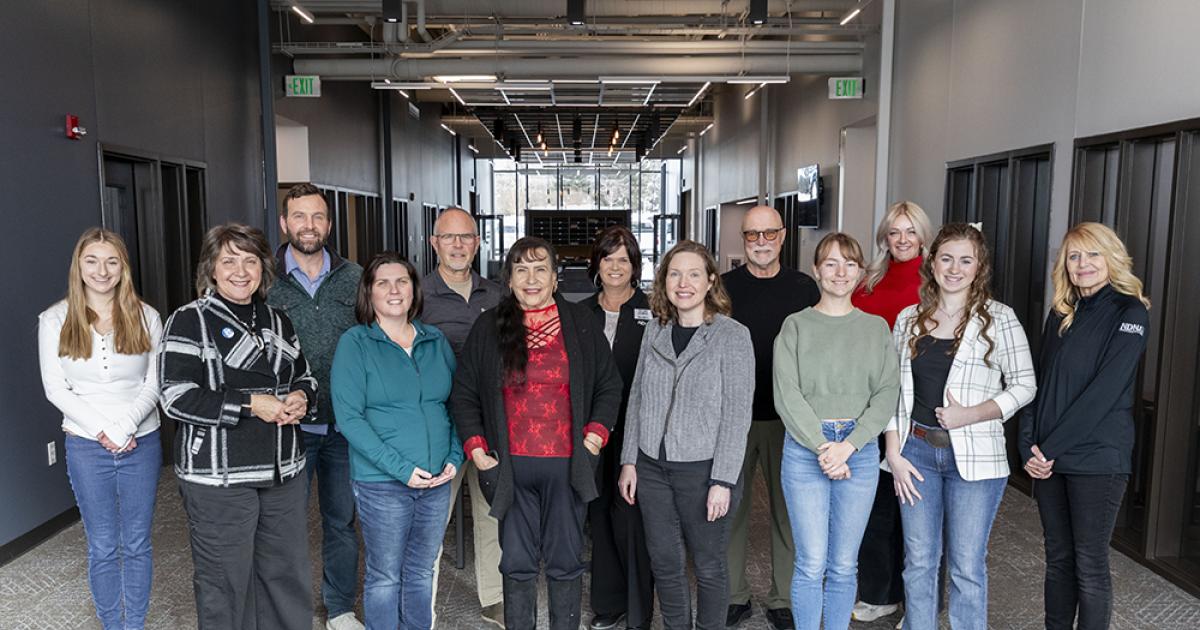
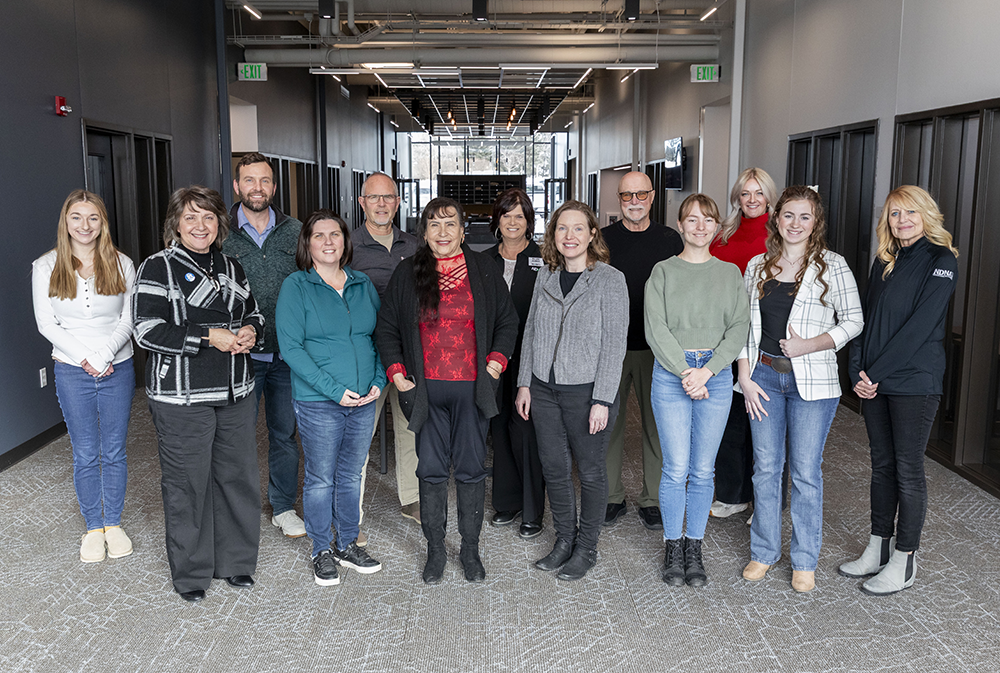
Members of the Future of Local News Initiative steering committee represented a diverse group of statewide media representatives, newspaper publishers, communicators and student journalists. Steering committee and working committee members, from left, are Keiara Lesmeister, Cecile Wehrman, Chris Gessele, Ann Alquist, Steve Andrist, Avis Red Bear, Ellen Huber, Amy Dalrymple, Rob Keller, Sophia Fafard, Cally Peterson, Kayden Schmitke and Joy Schoch.
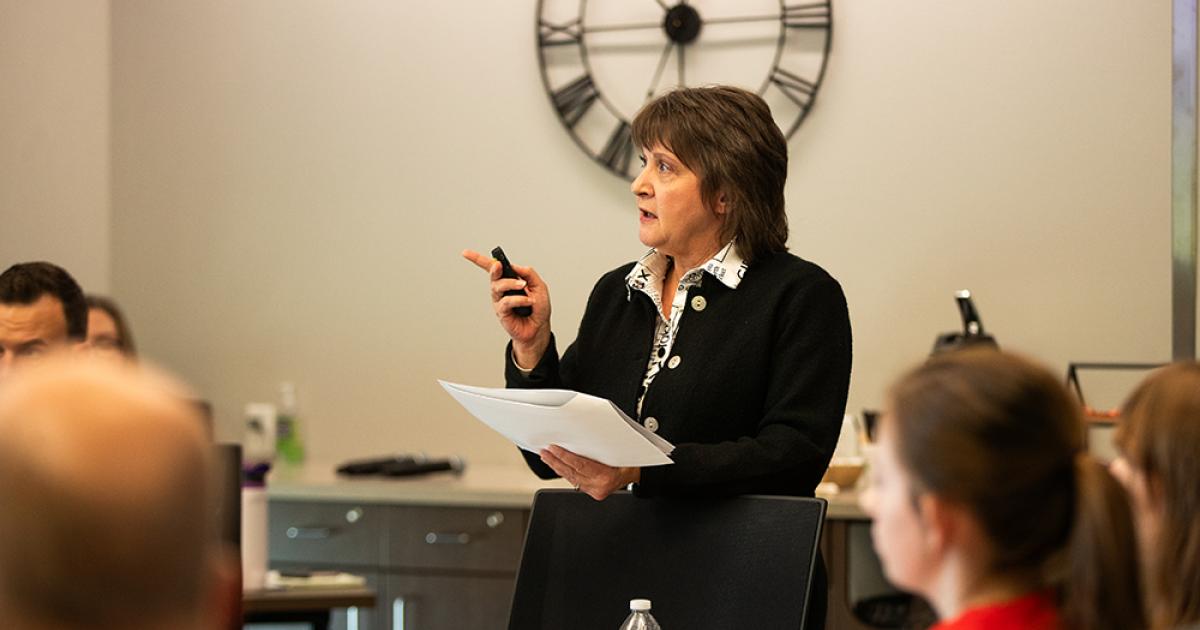
“It’s such an interesting and unusual and walled-off world for independent newspaper owners. They’re the only people in their community who do what they do, and very few people understand the sacrifices that are made and the slings and arrows that have to be dodged in order to do that for very low pay,” says Cecile Wehrman, executive director of the North Dakota Newspaper Association (NDNA). As the previous owner and publisher of the weekly The Journal, Crosby (which transferred ownership March 1), Wehrman is part of that small “fraternity of people” in the newspaper business.
“I believe in newspapers absolutely to the core of my being. I call it the gospel of newspapers. And I love, love telling the tale,” she says.
It’s a tale complicated by the rise of social and digital media and the information overload that oftentimes crowds out local news, postal service woes, shifting public perceptions that news should be free, and an industry changing hands to a new generation.
But with the challenges come opportunity, and North Dakota is charting a course forward for local news.
The Future of Local News Initiative concluded in January with a comprehensive assessment of local news conditions in the state, including surveys of newspaper executives, journalists, college journalists, news consumers and residents of North Dakota’s “news desert” counties which lack a resident newspaper. The research was conducted by Coda Ventures and funded through a Bush Foundation grant administered by the Rural Development Finance Corporation and North Dakota Association of Rural Electric Cooperatives (NDAREC) in partnership and NDNA.
Additionally, a study of newspapers serving Native American communities is still in the works.
“North Dakota’s local newspapers have long served as trusted, community-rooted institutions,” says Chris Gessele, NDAREC cooperative development specialist. “This initiative not only highlights the challenges they face, but also offers a roadmap for actionable solutions that can help sustain local journalism for decades to come.”
“The buzz is about the fact that we have this data, and what press association in this day and age could have afforded to spend money on research? Zero,” Wehrman says. “We’re incredibly fortunate to have access to this database and all this research, and it’s already yielding great information that we can share with legislators and grant sources.”
COMMUNITY AND CIVIC ENGAGMENT
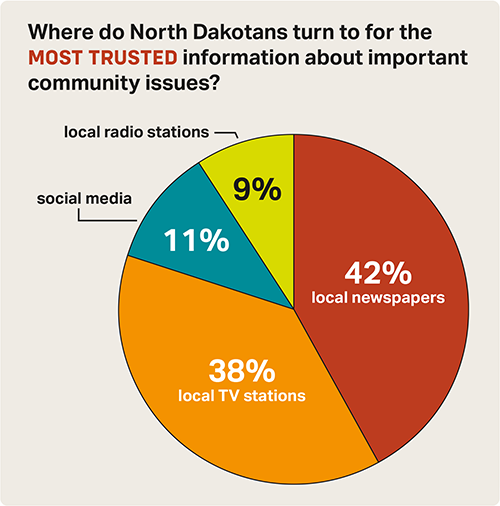
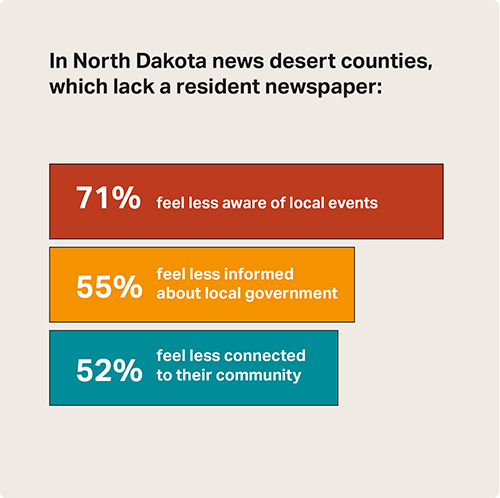
According to the research, nearly 90% of North Dakotans say having a local newspaper is important or very important, and local newspapers are considered the most trusted source for information about important community issues. And in areas without a resident newspaper, including Dunn, Sioux and Slope counties, residents experience notable civic impacts. This data serves as a warning sign to other communities about the negative impacts of losing a community’s newspaper.
“We attend the city council, county commission and school board meetings. We sit through long discussions about budgets, policies and decisions that directly impact taxpayers. Without journalists in the room, there is no one recording those conversations and no one regularly holding elected officials accountable for the choices they make,” says Jill Friesz, owner of GS Publishing which publishes seven weekly newspapers serving southwestern North Dakota.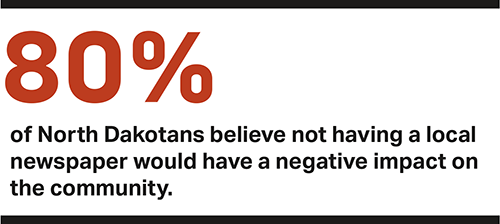 “It was really gratifying in the news desert study to see all the things people miss about having a newspaper,” Wehrman says. “If you lose a newspaper, you've lost the place where people know they can go for government information, public notices, city minutes, school board minutes, and you lose your history, because nobody is recording for posterity the good things that happen in your town.”
SUCCESSION PLANNING
One key finding revealed an urgent need for succession planning. As newspaper owners and publishers eye retirement, cultivating the next generation of publishers is critical for the sustainability of community journalism.
“Newspapers don’t look on paper like a good investment, so what bank is going to loan for a business that barely cash flows? And yet, so many newspapers do just pay for themselves. (The small weeklies) are not profit centers,” Wehrman acknowledges.
Fortunately, several non-owner journalists surveyed expressed interest in owning newspapers, identifying low-interest financing, grants and downpayment assistance as needed supports.
“It’s heartening to hear we have journalists who are interested in moving into ownership. Helping them attain that goal is a concrete effort we can prioritize,” Wehrman says.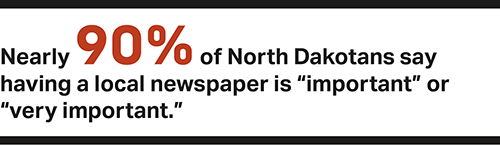
REVENUE MODEL
Despite rising postal costs and declining advertising revenue, more than 80% of independent newspapers reported operating at breakeven or better in 2024.
Still, finding new advertising sources and exploring a new revenue model that attracts new subscribers and more accurately reflects the cost of doing business will be key action items going forward, Wehrman says.
“Most people look at their newspaper almost as a utility, as though it will always be there, that it's impervious and impenetrable, and it's not. It's a small private business in 99% of cases, and like any business, if people don't support it, there's no one that's going to do it for free,” Wehrman says.
CARRYING THE RESEARCH FORWARD
“I was banging my head against the wall for years as a small weekly newspaper publisher trying to crack these nuts on my own for my own newspaper,” Wehrman says. “And I guess the longer I did it, and the more involved I became in NDNA, the more I realized these problems are the same for every newspaper. And so, wanting to help others find those solutions is, you know, work I enjoy.”
Armed with the research, Wehrman will lead NDNA in search of funding to continue the work. She hopes to test four strategies identified through the Future of Local News Initiative in the areas of succession planning, a print and digital newspaper sampling program to grow circulation, implementing a proven revenue model that has worked for some N.D. newspapers, and delivering tailored advertising programs and promotions.
“Those are just four things out of 50 that we would like to pursue,” Wehrman says. “What we're pursuing first are things that can make an immediate difference in strengthening the newspapers we have.”
“Nothing will ever change and we can’t expect to grow if we aren’t open to talking about new ideas and solutions,” Friesz says. “Being able to share some of the concerns the newspaper industry is experiencing is valuable, and it was great to brainstorm with people from different industries about what they want to see from North Dakota newspapers and listen to their ideas.”
___
Cally Peterson is editor of North Dakota Living. She can be reached at cpeterson@ndarec.com.