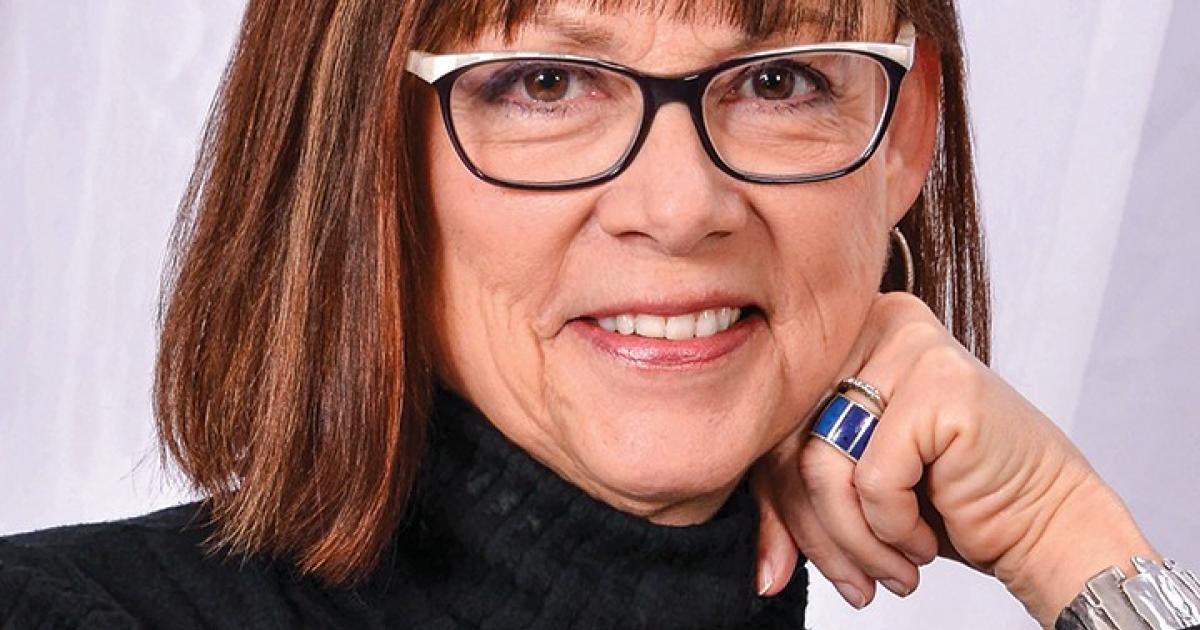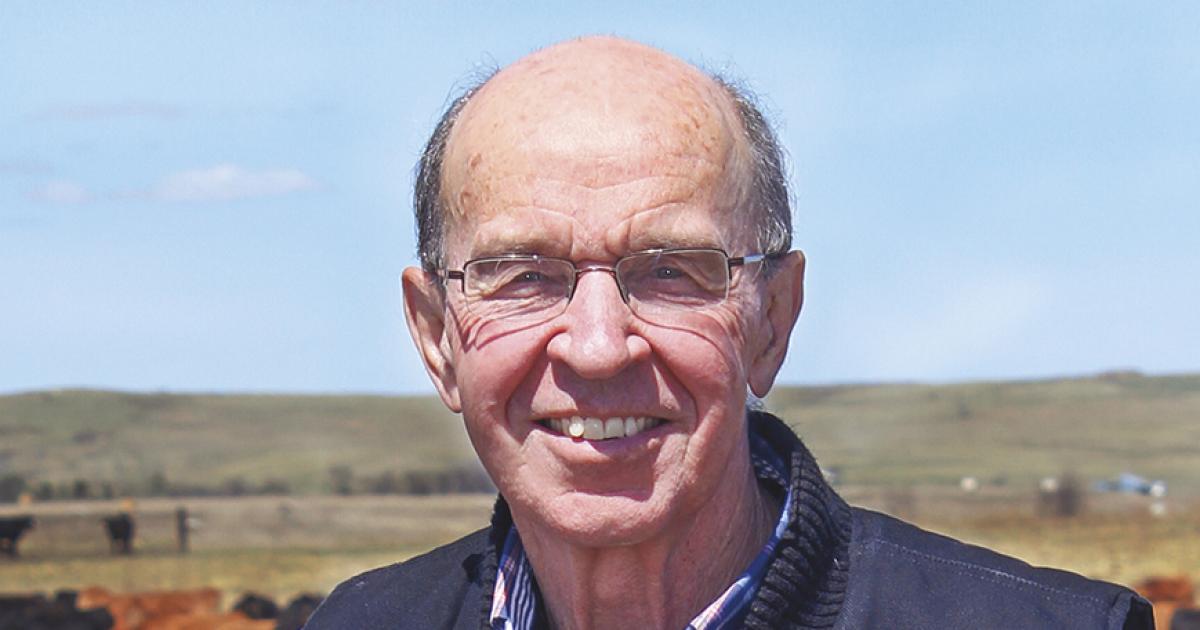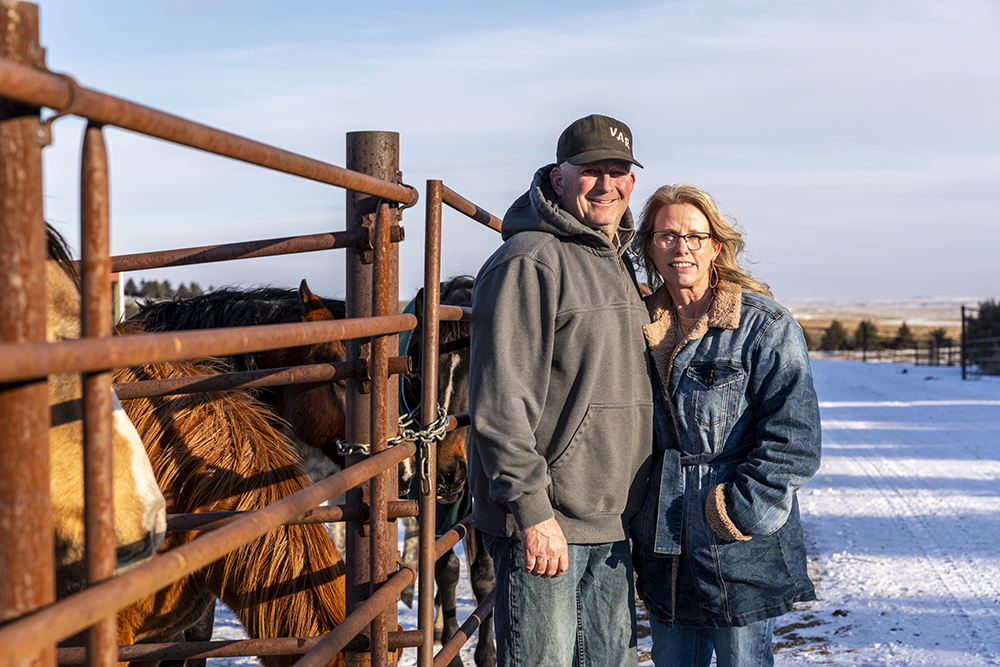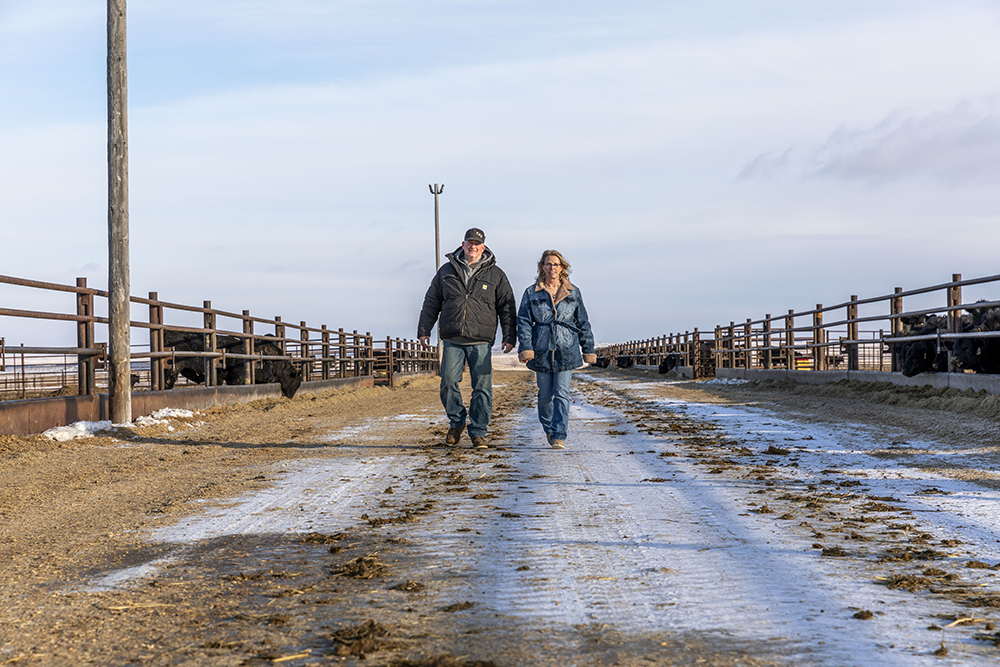

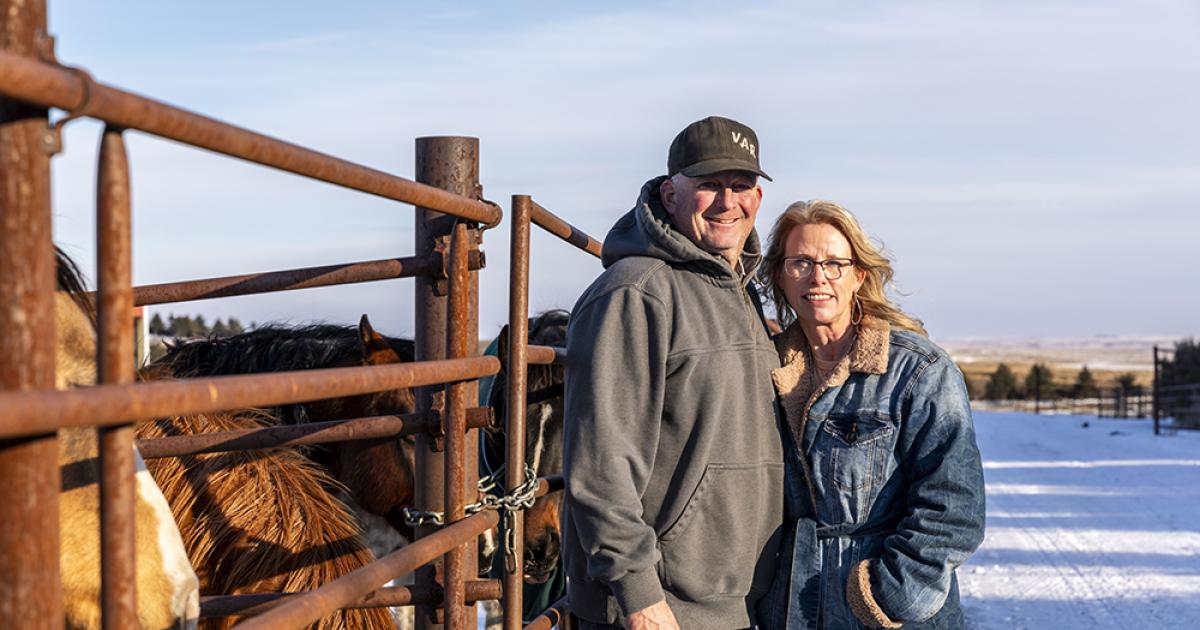
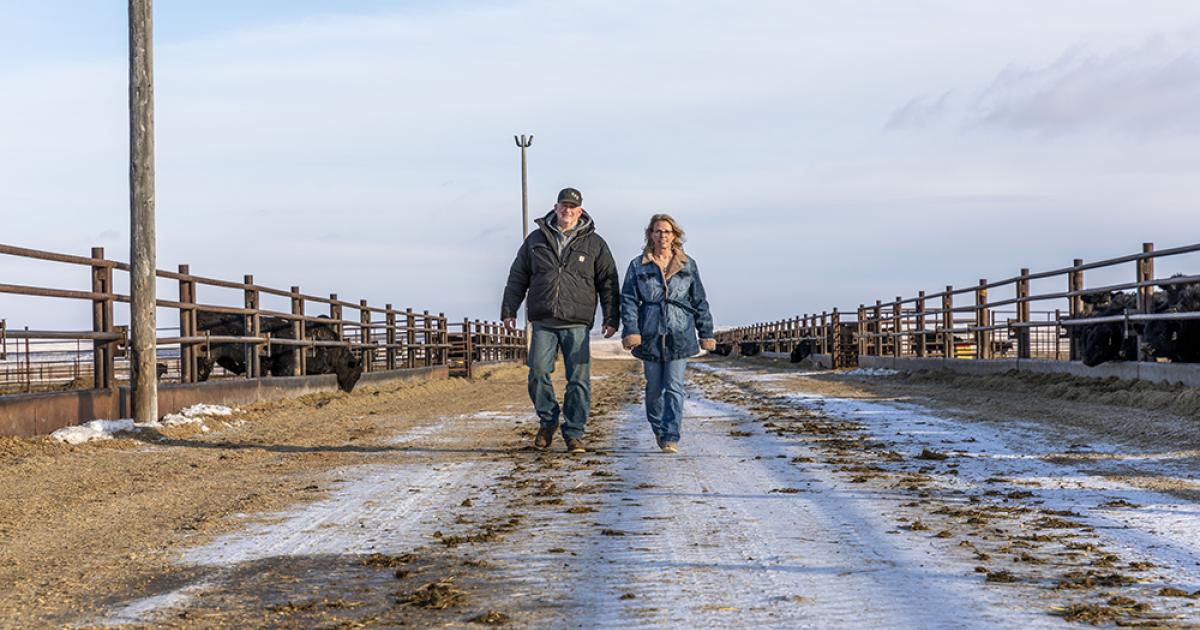
Capital Electric Cooperative Director Sara Vollmer and her husband, Troy, operate a Black Angus cattle ranch about 10 miles northeast of Wing. Photo by NDAREC/Liza Kessel
Sara Vollmer is living out her dream.
“You can’t not love the ranch,” she says.
The Leonard native met her husband, Troy Vollmer, while both were obtaining animal science degrees at North Dakota State University (NDSU).
“We both had the same advisor,” Sara recalls. “(The advisor) told Troy, ‘I’ve been to Wing, Troy. You best find a wife before you leave Fargo.”
Troy, it turns out, was a good student.
Sara and Troy married in 1996, and they became the third generation of Vollmers to join the family ranching operation about 10 miles northeast of Wing on Capital Electric Cooperative lines.
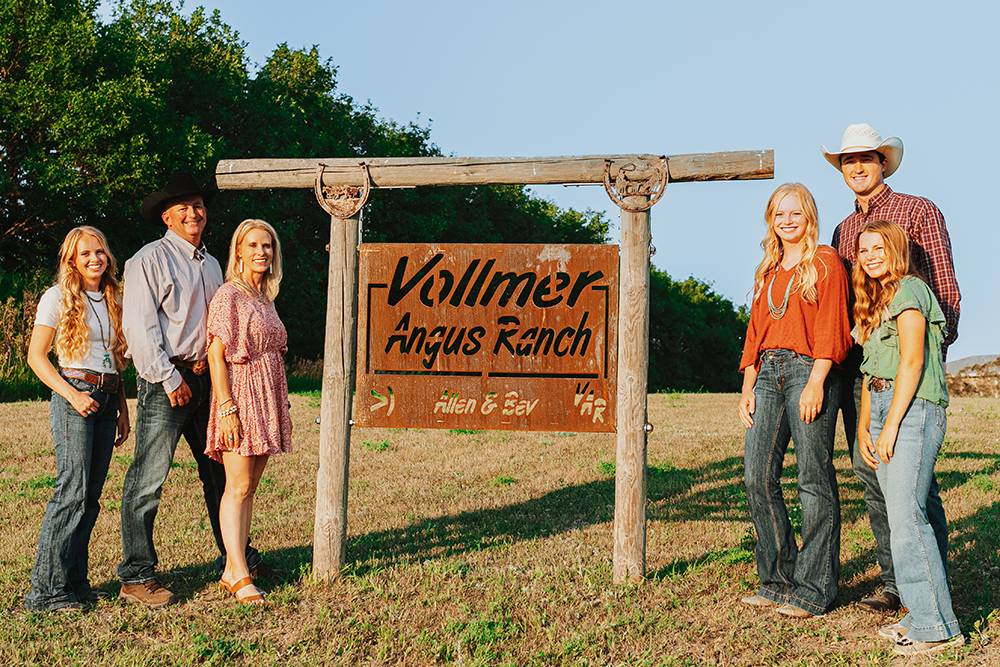
Vollmer Angus Ranch was started in 1952 by Alvin and Verna Vollmer, Troy’s grandparents. His parents, Allen and Beverly, still live and work on the ranch with Troy and Sara. They raise 500 head of Black Angus cattle and enough forage and feed for the herd.
“Being in agriculture was the dream,” Sara says.
A CAREER AND THE COMMUTE
“You know, I’m not sure I would have thrown a dart at Wing, North Dakota, to choose it, but it is where it is. It’s nice that it’s close enough I can still commute to Bismarck,” Sara says.
And commute she does – 120 miles each workday. Sara has worked at Bismarck State College (BSC) for 29 years, where she is currently the dean of continuing education and TrainND.
“Early on, I figured out you just have to chalk (the commute) up as part of your day, because if you hate it, that’s a long life,” she says.
Leaving the ranch to go to work also meant leaving her three daughters in another’s care. Luckily, they found the best child care for their daughters – Brooklyn, Haley and Callie – next door with Great-Grandma Verna.
“Their great-grandma played a very important part in their lives,” Sara says.
Having child care was a necessity in maintaining her off-farm employment, Sara says.
“I had the luxury of having not one, but two grandmas in the yard,” she says. “It was easier to go to work when they were just here, and Dad would drop them off, and I would pick them up. And even when they were sick, they could stay here, so that is something I never took for granted.”
THE BEST COWBOYS
For the Vollmers, there is no better childhood than being raised on a ranch, and they’ve learned sometimes the best cowboys are girls.
“The girls – Sara and the girls – have been so active in the ranch. We threw them on top of the horse since they were 4 or 5 years old,” Troy says, recalling tall tales that live in Vollmer family ranch lore. “We’ve always had the philosophy those girls can do anything anyone else can, and they’ve always been willing.”
In addition to work on the ranch, the Vollmer girls were active in rodeo growing up, and each competed in collegiate rodeo.
“They knew how to ride a horse before they knew how to ride a bike,” Sara says.
Brooklyn competed in rodeo at NDSU and earned her Doctor of Pharmacy. She now lives in Dickinson with her husband, Hayes LeMieux, who is an ag lender.
Haley competed in rodeo at Kansas State University (KSU) and is now the marketing director for Dakota Community Bank & Trust in Bismarck.
Callie is a freshman on the rodeo team at BSC, which added the sport to its athletic program in 2024.
With their daughters grown, Sara and Troy have shifted focus to diversifying their operation. They are working to establish a marketing storefront, through which they will sell their Black Angus beef.
“There is a movement that people want to know where their food comes from and how it’s raised,” Sara says. “How do you make the concept of ‘know your farmer’ and having high-quality locally grown meat for your family, but not having to buy a half of a beef at a time?”
Asking customers to buy a whole or half of an animal for processing can be cost-prohibitive or a freezer-space issue for families, Sara says. The Vollmers’ vision is to offer smaller quantities of beef, likely through a subscription service model, to appeal to a larger customer base.
If the ranch-to-market sales, or any part of the ranching operation, entices their family back to the ranch, Sara and Troy want to make sure there’s room for everybody.
“We want to leave it open to them. If they’re here full time, or if they have cattle here and come back and help, or with these direct meat sales, it’s just finding ways to involve them in the ranch,” Sara says.
BUSY IN OTHER WAYS
Although their free time isn’t filled with basketball games or hauling horses to rodeos anymore, the Vollmers are busy in a different way, Sara says.
Sara has served as a director on the board of her local electric cooperative, Capital Electric Cooperative, since 2022. As the only Capital Electric board director actively farming and ranching, Sara brings a rural perspective to the board.
“A lot of people take things for granted. Electricity is one of them, food is another. Some people don’t have a rural connection to how that is produced and how that is distributed,” Sara says. “The joke with the board is I’m the (member) at the end of the line. You recognize the board shifting more urban. There’s nine of us on the board, and many have only one meter. I have 11 meters. … I think (having a rural perspective on the board) is important, because it’s a totally different perspective when you start changing rate structures.”
Since Sara’s election to the board, rising costs of materials and inflationary pressures have made operating an electric utility more challenging. From January 2021 to January 2025, the average costs of electric distribution cooperative materials have increased by approximately 51%, according to RESCO, a major materials supplier for electric cooperatives in North Dakota.
As a result, the Capital Electric Cooperative board of directors voted to change the cooperative’s rate structure, adding a “grid capacity charge” and “on-peak demand charge” to member bills, to pay for rising costs and ensure equitability across all rate classes of the cooperative.
“In many ways, (the rate structure changes) didn’t benefit (the ranch) at all, but it is the fairest way to do it, because of what’s going on in the electric industry,” Sara says.
“Our calving facility,” for example, “there’s furnaces in there. When it’s 30 below in February when we’re calving out cows, regardless of what that costs us, we have to run them, because it’s the cost of doing business. Either we let those calves freeze to death or we turn the heaters on,” Sara says. “So, we (as board directors) don’t take those (ratemaking) decisions lightly.”
FOR THE NEXT GENERATION
Like many farm and ranch families, Sara and Troy know community and their way of life go hand in hand. They hope to build a legacy the next generation wants to continue, while helping to build a community – and cooperative – their children and grandchildren desire to be part of.
“One great thing about cooperative boards is you represent your community, and you represent all the classes. You don't just represent your own. You represent not only the rural residential members or the people with irrigation meters, but you represent all of them,” Sara says.
___
Cally Peterson is editor of North Dakota Living. She can be reached at cpeterson@ndarec.com
THE FOOD THAT GREW ME
Sara Vollmer, a Capital Electric Cooperative director, rancher and mom, created a family cookbook, “The Food that Grew Me,” for her three daughters. The cookbook contains recipes that were staples at the dinner table on the Vollmer Angus Ranch northeast of Wing. There are recipes that reflect the Vollmer family’s German heritage, including Grandma Verna’s pickles, kuchen and strudels. Plus, Sara included recipes of her Norwegian heritage.
“This book is dedicated to the girls that grew up on the Vollmer Angus Ranch,” Sara writes to her daughters in the cookbook’s dedication. “I hope that you reference this book often. May you think of home as you flip through the pages and create these dishes for you and your families.”
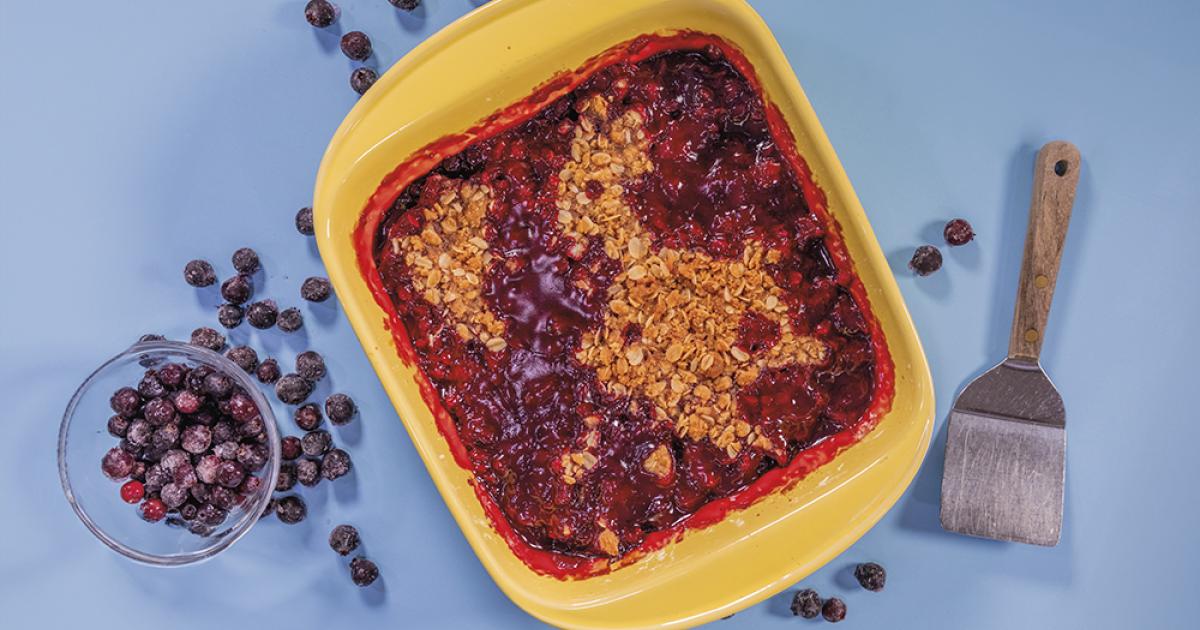
Sara shares two favorite recipes from the family cookbook with North Dakota Living, a Swedish meatball bake and rhubarb dream bars.